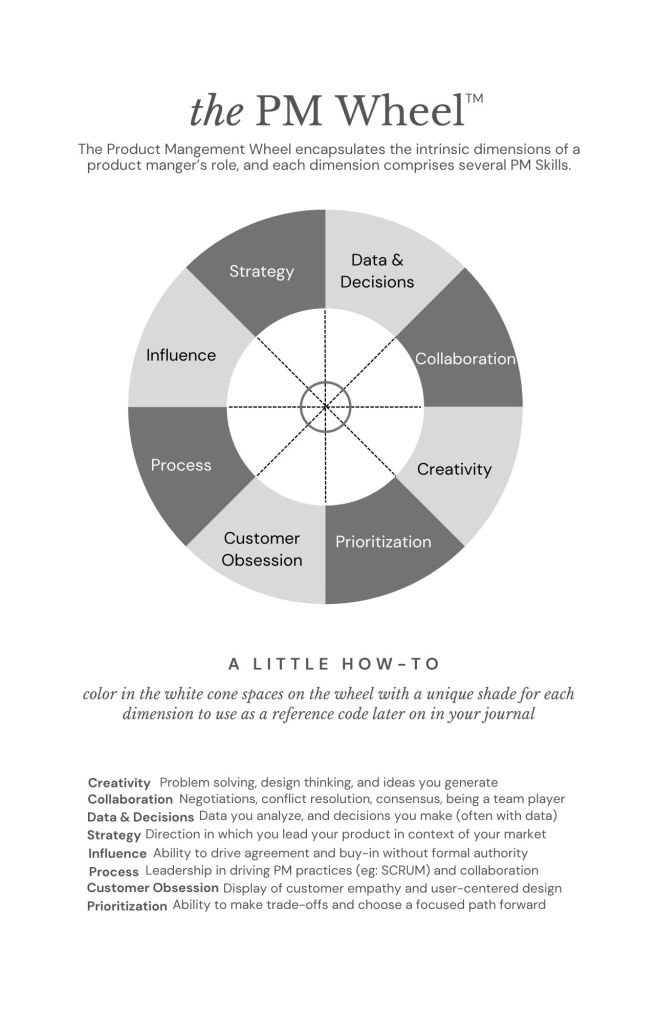
The PM Wheel is a unique feature of The Product Diary that helps users categorize their daily reflections by PM competency so that over time, they can easily access and analyze them across the full Product Management spectrum, not only to see where they’ve obtained most exposure, but also the experience they are lacking. This enables Product Managers to proactively plan their growth and expertise in their area of practice. Below, we look at the eight dimensions of the PM wheel in more detail.
1. Creativity
- What it is: Creativity for product managers isn’t just about coming up with novel ideas but involves applying creative thinking to problem-solving. It is about finding innovative ways to meet customer needs, differentiating the product, and tackling business challenges through new approaches. This includes visualizing new features, overcoming roadblocks, or even creating marketing campaigns to support the product launch.
- Why it’s important: In a competitive market, creativity is essential for distinguishing your product from others. Without creative problem-solving, a product manager may miss opportunities for innovation, fail to identify new user needs, or end up stuck in a cycle of predictable features. Creative thinking is also crucial when working within constraints (time, budget, resources), as it leads to finding efficient, innovative solutions.
- How to advance:
Case Example: Airbnb’s founder Brian Chesky and his team came up with a creative solution to grow their business when they struggled to find customers. They noticed that attendees at a design conference in San Francisco had nowhere to stay. They turned their own apartment into a temporary space for attendees to sleep on air mattresses—“air beds” was the foundation of their brand. This kind of innovative thinking allowed Airbnb to break into the market.- To improve creativity, actively expose yourself to different industries and ideas (via books, podcasts, cross-industry conferences).
- Participate in ideation workshops where diverse teams brainstorm together.
- Use creativity techniques such as mind mapping or SCAMPER (substitute, combine, adapt, modify, put to another use, eliminate, and reverse) to challenge assumptions and generate new ideas.
2. Collaboration
- What it is: Collaboration is the ability to work with a diverse set of stakeholders, each with different goals, interests, and expertise. It includes everything from managing team dynamics to negotiating trade-offs between different functions. A PM must bring together engineers, marketers, designers, and other departments to create a unified vision for the product and ensure that all voices are heard in decision-making.
- Why it’s important: Effective collaboration ensures that the team remains aligned toward a common goal and that the product will be well-rounded and feasible. In a cross-functional role like product management, it’s crucial to bridge different perspectives—technical, business, user-focused—and find solutions that satisfy all stakeholders.
- How to advance:
Case Example: Consider the collaboration behind the launch of the iPhone. Apple’s success came from the seamless collaboration between hardware engineers, software developers, designers, and marketers. The team’s shared vision and constant communication allowed Apple to innovate in a way that outpaced competitors.- To advance collaboration, practice active listening. When different teams offer competing ideas, encourage dialogue to understand their concerns and priorities.
- Facilitate regular check-ins and ensure transparency so all stakeholders feel heard and aligned.
- Use tools like Slack, Jira, or Trello to track progress and ensure smooth communication.
3. Data & Decisions
- What it is: This competency refers to the ability to interpret and act on both qualitative and quantitative data. A PM needs to analyze customer feedback, product usage analytics, market trends, and other metrics to drive product decisions. This could involve making trade-offs between different feature requests, optimizing for specific KPIs, or validating hypotheses.
- Why it’s important: Decisions backed by data reduce the risks associated with intuition-based choices. Relying on evidence ensures that the product development process is grounded in reality and responds to actual user needs and behaviors, rather than assumptions or opinions.
- How to advance:
Case Example: Netflix uses data-driven decision-making extensively. For example, the decision to create original content like “House of Cards” was driven by data analysis: Netflix identified a demand for political dramas and noted that many users who watched similar shows also liked Kevin Spacey. This insight guided their decision to invest in the series.- To enhance data-driven decision-making, familiarize yourself with tools like Google Analytics, Mixpanel, or Tableau.
- Invest time in learning how to conduct A/B testing to validate hypotheses.
- Regularly review the performance of your product and identify trends and anomalies in user behavior.
4. Strategy
- What it is: Strategy is the long-term planning and direction-setting for a product, ensuring that it aligns with company goals, market trends, and customer needs. It involves understanding where the product fits in the competitive landscape and crafting a path forward to achieve the product’s vision.
- Why it’s important: Without a solid strategy, the product might lose direction, or the development team could end up working on features that don’t align with business goals. A clear strategy ensures that resources are allocated efficiently and the product evolves in a way that provides the most value to customers and stakeholders.
- How to advance:
Case Example: Tesla is an example of strong product strategy. Elon Musk’s strategy for Tesla was not just to create electric cars but to make them desirable by focusing on high-end technology, performance, and sustainability. The broader strategic goal of creating an ecosystem of clean energy solutions shaped their long-term roadmap, helping them disrupt the traditional automotive industry.- To refine your strategy, regularly assess the competitive landscape, and use frameworks like SWOT (Strengths, Weaknesses, Opportunities, Threats) to evaluate your position.
- Build a product roadmap that reflects both short-term wins and long-term vision, adjusting as you learn more about customer needs.
5. Influence
- What it is: Influence is the ability to get others on board with your ideas, without necessarily having formal authority over them. As a PM, you often need to convince team members, executives, and external stakeholders to support your vision or make difficult decisions in the absence of direct control.
- Why it’s important: A PM’s ability to influence can make or break product decisions. If you cannot get buy-in from key stakeholders, you may struggle to move the product forward, even if your ideas are strong. Successful influence ensures smooth collaboration and prevents bottlenecks in the decision-making process.
- How to advance:
Case Example: Amazon’s Jeff Bezos is a prime example of influencing without authority. Bezos has a reputation for pushing his vision, often persuading his leadership team to embrace bold, unconventional ideas. His insistence on customer obsession, despite resistance at times, has shaped Amazon into the retail giant it is today.- Build your credibility through expertise and a proven track record. When presenting ideas, tie them to both the company’s goals and customer needs.
- Engage in active persuasion: ask questions that lead others to see the benefits of your proposals. Build relationships and trust with stakeholders.
6. Process
- What it is: Process competency is about knowing how to manage and streamline workflows in product development, ensuring teams follow best practices (e.g., Agile, Scrum) that maximize efficiency and collaboration.
- Why it’s important: Well-defined processes ensure that projects stay on track and that teams are aligned. Without clear processes, work can become chaotic, deadlines may slip, and important details can be missed.
- How to advance:
Case Example: Spotify has a famously flexible yet disciplined approach to product development. They use an Agile methodology with “squads” (small, cross-functional teams), each squad working on a specific feature or product area. This process allows for rapid iteration and collaboration without losing focus on overall goals.- Invest in process improvement by continuously evaluating team workflows, identifying bottlenecks, and experimenting with new tools or practices.
- Learn and advocate for Agile, Scrum, or other frameworks suited to your team size and needs. Hold retrospectives after major sprints to refine processes.
7. Customer Obsession
- What it is: Customer obsession means understanding customers’ pain points, desires, and behaviors at a deep level. It involves focusing on delivering value to the user at every stage of the product development cycle and ensuring that user feedback shapes the direction of the product.
- Why it’s important: If the product doesn’t meet user needs or solve their pain points, it’s unlikely to succeed in the market. Customer obsession ensures that the product aligns closely with market demands and stays ahead of competitors.
- How to advance:
Case Example: Zappos is a classic example of customer obsession. Their CEO Tony Hsieh made customer service the core of their business, going as far as to offer a 365-day return policy. This deep commitment to understanding and delighting customers helped Zappos build a loyal customer base and become a leader in online retail.- Regularly interact with users through surveys, user interviews, or customer service touchpoints.
- Use data analytics to track customer behavior, identify pain points, and prioritize product features accordingly.
- Design your product based on user stories that capture real-life customer experiences.
8. Prioritization
- What it is: Prioritization involves making decisions about which product features, tasks, or projects to focus on, balancing competing demands and constraints such as time, resources, and impact.
- Why it’s important: As a PM, you’ll rarely have the luxury of working on everything at once. Prioritization allows you to focus on what will bring the greatest value to the business and users. Effective prioritization maximizes impact and ensures that teams don’t spread themselves too thin.
- How to advance:
Case Example: Google is well-known for its data-driven approach to prioritization. When working on its search algorithm, the team used user engagement metrics to prioritize which updates and improvements would have the most significant effect on user experience and overall search quality.- Use frameworks like MoSCoW (Must Have, Should Have, Could Have, Won’t Have) or RICE (Reach, Impact, Confidence, Effort) to evaluate priorities.
- Collaborate with stakeholders to ensure you are prioritizing tasks that align with both business goals and user needs.
- Constantly reassess priorities based on user feedback, market shifts, and team capacity.
These competencies, when honed, are critical for a product manager’s success. They ensure that PMs not only execute efficiently but also lead the product toward success in an ever-changing market.
 The Product Diary