If you work as a product manager, your day likely consists of a sequence of high-stakes, rapid context switches. You move from a morning standup to a roadmap alignment meeting, join a call to unblock a localized deployment issue, and conclude the afternoon negotiating with a design lead over micro-interactions. By the time you close your laptop, you face a long list of unfinished tasks and competing priorities.
In the midst of this chaos, the suggestion to start journaling can sound like a soft, passive self-care routine. It is easy to picture it as an emotional outlet or a hobby reserved for individuals with abundant free time. However, viewing journaling merely as a method for recording the past misses its true mechanical purpose.
For a product manager, a journal is a tool to calibrate your decision-making engine. It serves as a practical mechanism for evaluating your own choices. When you document the events of your day, you change how your brain processes information, builds intuition, and executes strategy for the future. The cognitive science behind this practice explains why a product log is one of the most underutilized levers in a product career.
The Retroactive Mechanism: Future Planning Through Past Review
The common misconception about journaling is that its value flows backward, operating on the assumption that one writes things down solely to remember them later. Cognitive science demonstrates a different reality: the act of structured, retroactive reflection modifies future behavior.
When you sit down to document a shipping delay, a friction point with engineering, or a misaligned product launch, you engage in what psychologists call retrospective sensemaking and implicit pattern formation.
[Log Yesterday’s Decision] ──> [Identify the Gap/Error] ──> [Automatic Cognitive Adjustment] ──> [Better Judgment Tomorrow]
This loop works like an automated software test for your mind:
- You log yesterday’s decision, writing out exactly what you decided and why you decided it.
- You see what went wrong, as the distance between your expectations and reality becomes visible on paper.
- Your brain automatically adjusts; by forcing your subconscious to confront the gap, your neural pathways update your predictive models.
- You walk into tomorrow’s meeting with better judgment, recognizing the early warning signs of a problem before it occurs.
In academic terms, this process is driven by the self-explanation effect (Chi, M. T., et al., 1989) and metacognitive recall (Flavell, J. H., 1979). When you explain a situation to yourself in writing, you understand it more deeply than when you simply ponder it (Chi et al., 1989). By writing down how you handled a complex cross-functional dependency or a shifting market requirement today, you perform a rehearsal. You train your brain to move from reflecting-on-action, which is thinking about an event afterward, to reflecting-in-action, which means spotting and correcting the issue in real time during a high-pressure meeting.
Overriding Intuition: The Pause as a Cognitive Reset
Product managers operate in a state of constant cognitive overdrive. Because you face an uninterrupted barrage of incoming requests, communication pings, and customer escalations, your brain defaults to what psychologist Daniel Kahneman calls System 1 thinking (Khalil, 2025).
- System 1 is fast, instinctive, automatic, and prone to bias (Khalil, 2025). It relies on shortcuts and gut reactions to make split-second decisions (Tay et al., 2016). While useful for avoiding immediate danger, it proves hazardous when deciding whether to pivot a core product feature or cut scope for an upcoming release.
- System 2 is slow, deliberate, analytical, and logical (Tay et al., 2016). It is the mode of thinking required to calculate trade-offs, evaluate long-term technical debt, and assess market risks (Tay et al., 2016).
The physical act of opening a journal and writing acts as an immediate circuit breaker for System 1. It introduces a deliberate, friction-heavy cognitive pause. This pause stops you from acting on impulse or organizational pressure, creating the space to activate metacognitive processes and deliberately switch to System 2 reasoning (Tay et al., 2016).
Analysis from business publications, including Forbes, highlights this structural delay as the exact point where vital professional benefits like stress reduction and creativity boosts take root (Paulise, 2023). Giving the brain a moment of isolation allows it to approach complex corporate problems logically rather than reactively, leading directly to enhanced problem-solving skills (Paulise, 2023; Morgan, 2024).
This is a quantifiable benefit. Quantitative research from Harvard Business School, HEC Paris, and the University of North Carolina revealed that employees who spent fifteen minutes reflecting at the end of their day performed nearly twenty percent better on subsequent tasks than those who did not reflect. The pause pays compounding dividends over time.
The Experiential Learning Cycle: Moving From Action to Mastery
There is a vast difference between possessing ten years of product management experience and possessing one year of experience repeated ten times. Time on the job does not guarantee growth. Real mastery requires a structured process to evaluate your experiences.
Educational theorist David Kolb mapped this out in his Experiential Learning Cycle, which outlines how humans transform concrete events into lasting mental frameworks. Without a journal, many product managers bounce chaotically between execution and experimentation, completely skipping the intellectual work required in the middle.
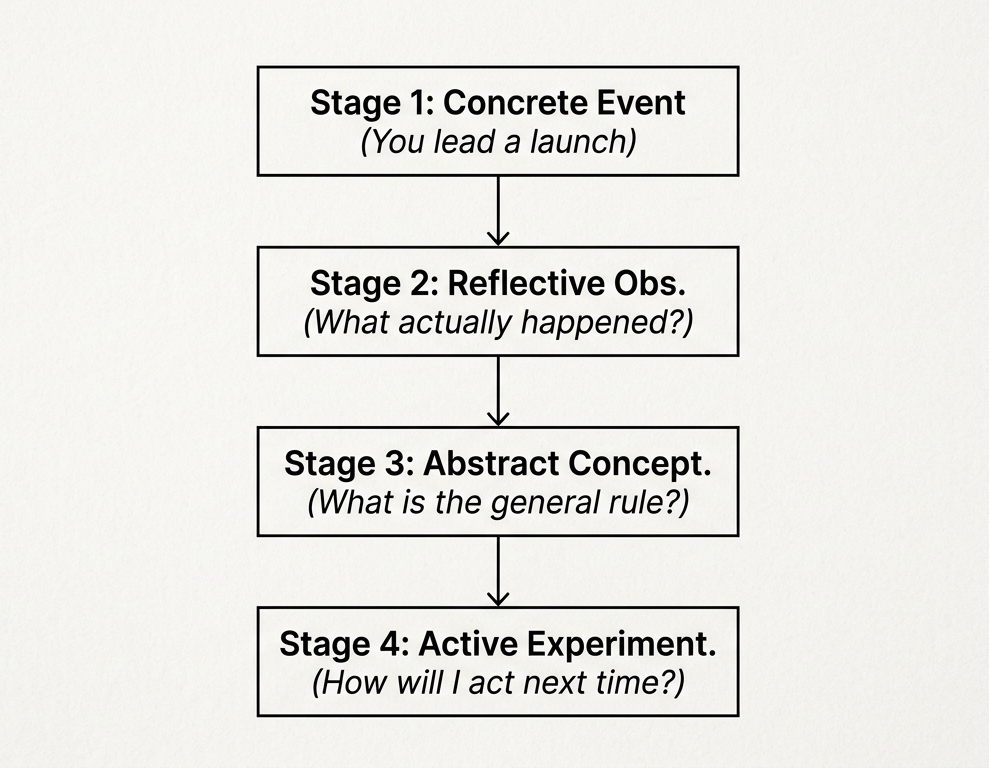
- Stage 1 (Concrete Experience): You execute a task, such as presenting a new product strategy to your executive leadership team, where it gets picked apart due to an unaddressed data governance question.
- Stage 2 (Reflective Observation): You step back from the raw emotion of the meeting to objectively review what occurred. You open your journal and write down the sequence of events, the specific questions asked, and where the conversation derailed.
- Stage 3 (Abstract Conceptualization): You zoom out to find the broader principle. Instead of thinking that the executive was simply in a difficult mood, you realize that leadership will reject a new strategy if they cannot see how it respects current data security guardrails. You have turned an anomaly into a core product principle.
- Stage 4 (Active Experimentation): You design a concrete plan to test this new rule during your next project milestone.
By utilizing a journal to navigate all four stages, you cease reacting to isolated fires and begin building a systematic playbook for your career. This deliberate progression aligns with research documented by Harvard Business Review, which notes that taking time to review what you have learned helps pass information from short-term to long-term memory (Morgan, 2024). For a product manager, this memory consolidation is exactly what strengthens your core product sense over time, ensuring that lessons from past iterations actively shape future strategies.
Extracting Heuristics and Hardening Your Tacit Knowledge
As you advance from an associate product manager to a director, vice president, and chief product officer, the nature of your knowledge changes. You move away from explicit knowledge, which includes things you can read in a textbook, and toward tacit knowledge.
Tacit knowledge is highly nuanced, deeply contextual, and difficult to explain to colleagues. It is your ability to sense when an engineering estimate is overly optimistic, when a user research participant is merely saying what you wish to hear, or when a stakeholder is quietly withdrawing support from a project. Journaling acts as an encoding mechanism that converts this ephemeral, gut-level tacit knowledge into clear, actionable heuristics, which serve as internal rules of thumb. This ongoing clarification of your own perspective is a core pillar of long-term leadership development and improved productivity (Paulise, 2023).
Creating a Decision Black Box
One of the greatest dangers in product management is hindsight bias, which is our innate tendency to rewrite our own mental history after an outcome is already known. When a risky feature succeeds, we tell ourselves we knew it would all along. When it fails, we look back and convince ourselves that the failure was inevitable or the fault of someone else.
By writing down your reasoning before an outcome is known, you create an unalterable black box for your mind.
| Before the Launch (Journal Entry) | After the Launch (The Reality) | The Realization / Learning |
| “I am greenlighting this feature even though user testing showed thirty percent confusion, because marketing says we need it for the campaign.” | The feature launches and user retention drops immediately due to onboarding confusion. | You cannot sacrifice core usability to satisfy short-term promotional windows. Your journal prevents you from blaming the engineering team for poor implementation. |
This practice keeps you honest. It forces you to confront your own logic, strips away revisionist history, and ensures that you actually learn from your missteps instead of smoothing them over to protect your ego. Ultimately, it refines your product intuition, systematically improving how you build your products and what products you choose to build.
A Framework for Your Daily Product Log
To build this systemic habit, you do not need to write long, unstructured essays every night. Instead, you can use a targeted framework designed specifically for the pressures of product management.
Spend the final ten minutes of your workday answering three simple, objective questions:
1. What was the core hypothesis of today?
What did you expect to happen today? For example, you might write that you expected the engineering team to agree to the revised sprint scope because you cut the lower-priority design polish.
2. What was the actual outcome, and where was the gap?
What actually occurred? For example, you might note that they still pushed back because cutting the design polish did not solve the underlying database architecture constraint.
3. What is the reusable principle for the future?
What rule can you take away from this? For example, you might conclude that you should never assume scope cuts save engineering time without verifying which specific technical stack is causing the bottleneck.
The Bottom Line
Product management is a demanding discipline because it asks you to process massive amounts of raw, chaotic, and often conflicting inputs every single day. If you lack a reliable mechanism to filter, sort, and internalize those inputs, they turn into cognitive clutter, stress, and eventual burnout.
A structured journal helps you process your career experiences. It takes the chaotic events of your daily corporate life, strips away the noise, and leaves you with expert intuition, sharper mental models, and better judgment.
You can choose to stop managing your product entirely in your head and begin thinking on paper. Your future product, your team, and your mind will benefit from the choice.
References
Flavell, J. H. (1979). “Metacognition and Cognitive Monitoring: A New Area of Cognitive-Developmental Inquiry.” American Psychologist.
Schön, D. A. (1983). The Reflective Practitioner: How Professionals Think in Action.
Di Stefano, G., Gino, F., Pisano, G. P., & Staats, B. R. (2016). “Making Experience Count: The Role of Reflection in Individual Performance.” Harvard Business School Working Paper.
Khalil, R. (2025). Adaptive Decision‐Making “Fast” and “Slow”: A Model of Creative Thinking. A Model of Creative Thinking. https://pmc.ncbi.nlm.nih.gov/articles/PMC11892090/
Morgan, S. (2024). Eight Research-Backed Benefits of Journaling. https://stevermorgan.com/2024/07/08/eight-research-backed-benefits-of-journaling/
Paulise, L. (2023). The Power Of Journaling And Why It Matters In Your Career. Forbes. https://www.forbes.com/sites/lucianapaulise/2023/08/14/the-power-of-journaling-and-why-it-matters-in-your-career/
Chi, M. T., et al. (1989). “Self-Explanations: How Students Study and Use Examples in Learning to Solve Problems.” Cognitive Science. Self-Explanation (& Think-Alouds) | ABLConnect
Tay, S. W., Ryan, P. M., & Ryan, C. A. (2016). Systems 1 and 2 thinking processes and cognitive reflection testing in medical students. Canadian Medical Education Journal, 7(1), e97–e103.
 The Product Diary